
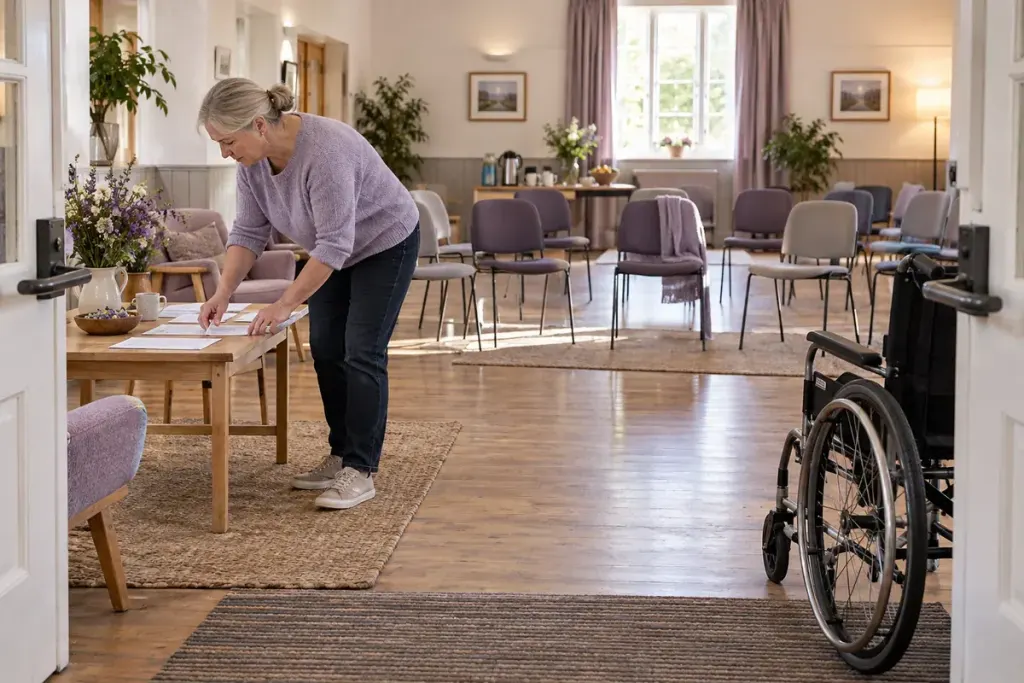
A gathering can feel welcoming in the invitation and confusing at the entrance. The right door is locked, the information desk is upstairs, or everyone seems to know an unwritten routine. Those details matter before a speaker says a word.
For a small discussion group, workshop or neighbourhood meeting, begin with the journey of someone attending for the first time. The aim is to remove avoidable uncertainty while leaving room for participants to describe needs you have not anticipated.
Walk the route described in the invitation
Start where a visitor would arrive, rather than at the room you already know. Is the advertised entrance actually open? Can someone identify the meeting without asking several strangers? Are instructions useful to a person who cannot rely on a photograph of the building?
Write down what you can confirm and what needs checking with the venue. Avoid calling a space fully accessible after seeing a ramp. The W3C accessible-events checklist includes entrances, meeting rooms, stages and bathrooms, and recommends inviting participants to explain accessibility requirements. Use that as a starting point for a conversation, not a substitute for assessing the actual venue.
Give practical information before someone has to ask
A short arrival note might identify the entrance, transport options, expected finish time and a contact for access questions. If a limitation remains, describe it plainly. “The meeting room is reached by twelve steps and there is no lift” gives a reader more useful information than an unexplained accessibility symbol.
For an illustrative example, imagine a book group that meets behind a café. A sentence saying that the courtyard gate is the meeting entrance, accompanied by a clear route description, can prevent a newcomer from assuming the café is closed and going home. Confirm the route before publishing it.
Let people participate without performing confidence
Not everyone wants to introduce themselves to a full room immediately. Explain the format at the beginning and make it clear when people can listen, ask a question or take a break. Consider a written way to contribute alongside discussion, provided someone is responsible for reading it.
Keep access requests separate from public introductions. A participant should not need to announce personal medical information to obtain a practical adjustment. Ask what would help them participate, agree what can be provided and share details only with people who need them to arrange it.
Assign the small jobs that otherwise disappear
For your own planning sheet, give each unresolved issue an owner: who confirms the entrance, who updates the invitation, who welcomes late arrivals and who responds if the room changes? A note without a responsible person is easy to mistake for a completed task.
After the gathering, ask a specific question such as “Was anything about finding or joining the session unclear?” Record the answer alongside what you will change next time. A useful improvement may be as ordinary as moving a sign or sending directions a day earlier.
Welcoming design is an ongoing practice. The strongest evidence is not how inclusive an invitation sounds, but whether people can understand the arrangements, express a need and take part without unnecessary obstacles.